


Dear Doc:
The United States Supreme Court is now, more than ever, in the news every week. It seems to be doing unprecedented things, which, as I understand our system, is not necessarily a good thing. But I also seem to recall that the Court used to handle many more cases. What can you tell me?
Signed,
A Bewildered ConLaw Student
Dear BCS:
Your impressions are quite correct. The “Supremes” seem to be quite active, but not in the way citizens and scholars of Constitutional Law have traditionally understood how the Court operates. In recent years, the “shadow docket” has taken on many more cases. Shadow docket means cases that come to the Court on an emergency basis, rather than after an appeal, full briefing, and oral argument, as is normal. These emergency cases are often decided without any briefing or argument, and many times, without full opinions being published. They often are issued mere days after being submitted. Although the decisions are binding on the lower courts, without published opinions, it is increasingly difficult for judges to know the limits of the decisions, and this makes for a lot of uncertainty in the justice system.
Some scholars have written that one reason for the shadow docket is the workload shouldered by the Justices. After all, the thinking goes, in 1940 the United States population was 132 million, while today, it is 343 million. Using the 2025 Supreme Court statistics – that there were 56 published decisions last year, gives about 0.16 decisions per million people, compared with approximately 1.14 per million in 1940. The per-capita output of published Supreme Court decisions is therefore roughly 86% lower than it was in 1940. We still have only 9 justices on the Court, even though the nation has 2.6 times as many people! So, the Doc asks, what’s going on?
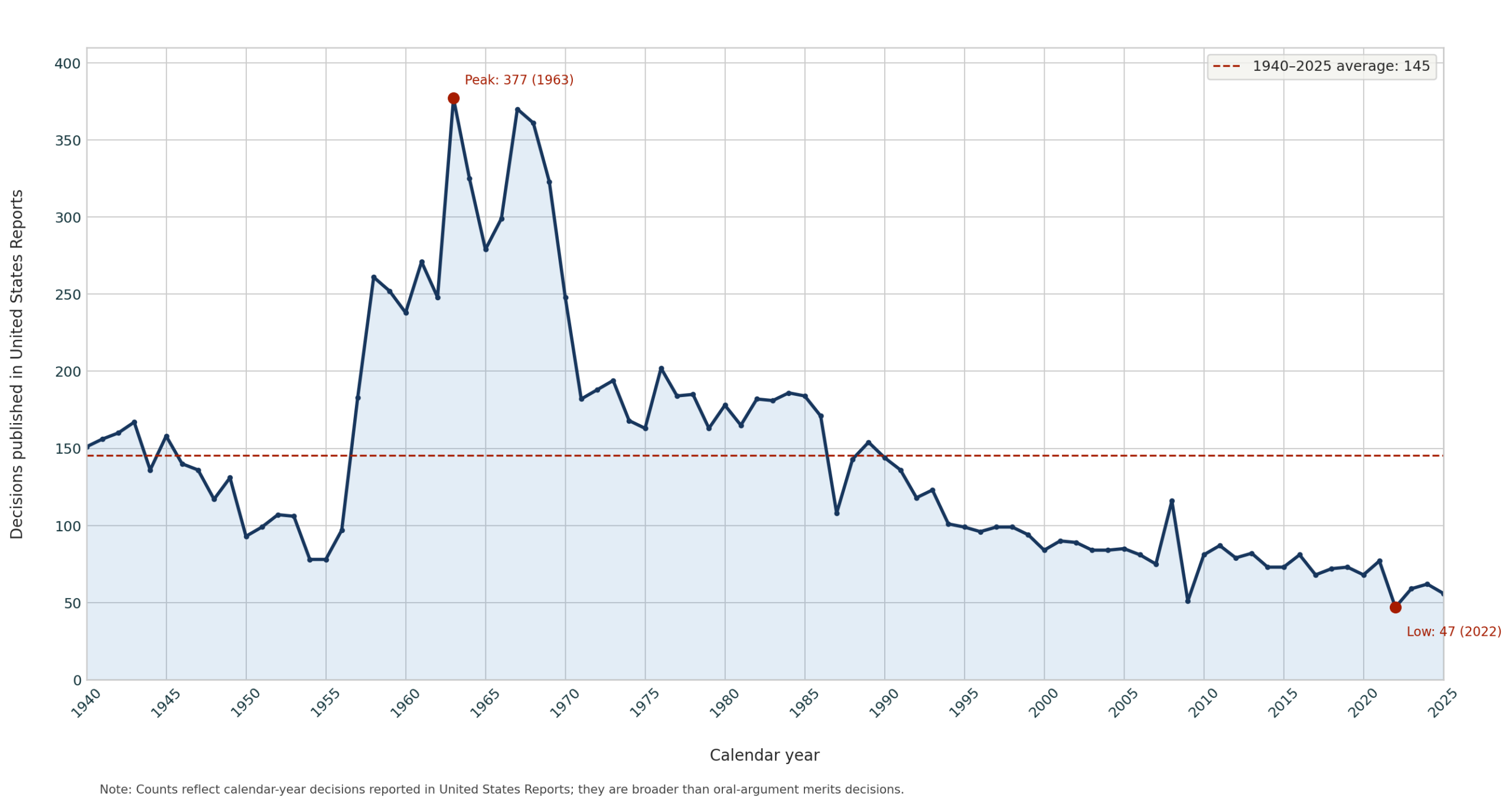
As you can see in this graph, since the early 1960s, our Justices seem to be handling far fewer cases, even though we have many more people and disputes. The Supreme Court is not required to consider every case that comes before it. Most cases come by way of an application for a writ of certiorari, and most of those applications are denied. Nevertheless, the number of applications for “cert” has increased roughly in line with the population (excepting “in forma pauperis” petitions, which mostly come from incarcerated persons), but the rate at which they are denied has grown faster, meaning that most cases never get decided by the Court. According to the Court’s own published records, 98.3% of cert applications are denied.
And what is the impact on patent law? It’s the Doc’s opinion that in recent years the Court has so severely limited what may be patented that we are almost back to the days when the Court required a “flash of creative genius” for an invention to be awarded a patent. Congress overruled that requirement when, in 1952, it revised the Patent Statute, but here we are. The Court grants only one or two cert petitions in patent cases each year and has steadfastly refused to clarify or revisit its most restrictive decisions, eroding the United States’ lead in patented computer, pharmaceutical, and biotechnology inventions.
So what is going on? It seems that the justices are working less, but making decisions that more often drastically change the law by reversing longstanding precedent, and doing so without detailed written opinions far more often than they have in the past. That, says the Doc, may be why people are now discussing imposing term limits for justices, as well as increasing the number of justices on the Court (which is set by Congress, not by the Constitution). Only time will tell whether the Court will change course, or have change imposed on it.
Have questions about intellectual property law? The attorneys at LW&H do this stuff, and do it well. Give them a call.
Until next month,
The “Doc”
— Lawrence A. Husick, Esq.