

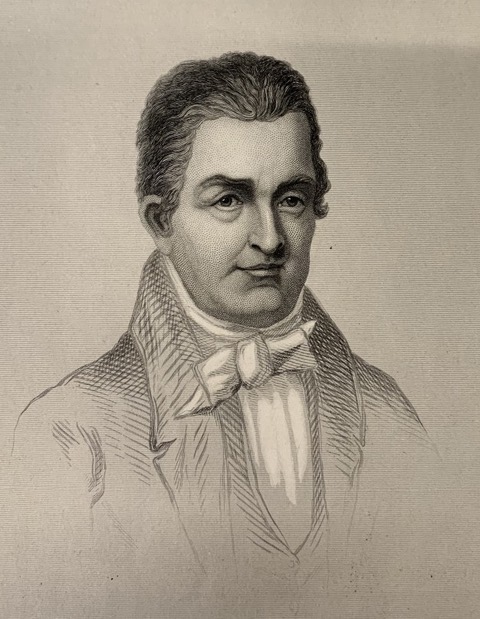
The year was 1809. Oliver Evans, Philadelphia inventor, author, and entrepreneur, was having a very bad day. He was in the middle of yet another lawsuit against yet another person who copied Evan’s automated (and patented) flour mill. A justice of the U.S. Supreme Court, clearly hostile to inventors, announced in court that a patent right was “an infringement of the public right.” The justice then delivered an opinion, apparently in draft, finding against Evans. After twenty years of trying to enforce his patents, Evans could take no more. He gathered all of his notes, plans, and drawings of inventions and burned them in front of his family. Evans said that he was the victim of a patent system that failed to protect inventors.
Despite his moment of despair, Evans did not give up. The Supreme Court eventually found in his favor and a special act of Congressextended the life of his patent.
Evans’ automated flour mill patent was the third U.S. patent issuedand was signed by both George Washington and Thomas Jefferson in 1790. Both Washington and Jefferson were apparently impressed, and both became early adopters of Evans’ technology, paying license fees and installing Evans’ mills on their estates. Washington’s mill, installed in 1791, became a profit center for Mount Vernon.
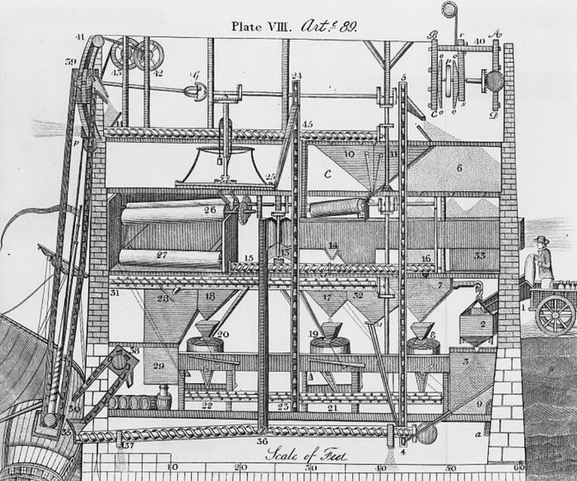
What Evans invented was the automated production line– grain went in one end and flour came out the other. With Evans’ automated mill, the labor requirements and costs dropped dramatically, with one man doing the work of five. To promote his milling system, in 1795 Evan’s published a book – “The Young Mill-Wright and Millers Guide.” Evans’ book described the design and operation of his automated mill in detail. Evans’ book stayed in print through fifteen editions until the Civil War, 41 years after Evans’ death and several decades after his patent expired.
Oliver Evans was not a one-trick pony. In addition to many other inventions, he created the high-pressure steam engine, which he patented, capable of much higher power and far lower weight than previous designs.
Evans operated factories in Philadelphia and Pittsburgh to make and sell his engines. He dreamed of steam-powered land transportation, but was unable to secure funding. That is, until 1804. In that year he contracted with the Philadelphia Board of Health to build a steam dredger for Philadelphia Harbor. Evans built his ‘Oruktor Amphibilos’ (Latin for “amphibious dredge”). The machine was twelve feet wide, thirty feet long, and weighed seventeen tons. And it had a hull. And wheels. The wheels were powered by a steam engine through a chain drive. Evans drove the machine from his shop and down Market Street in Philadelphia, circling the Central Square several times. He then drove to and into the Schuylkill River. The wheels were removed and a paddle wheel attached. The Oruktor Amphibilos spent the rest of its days doing what dredgers do.1
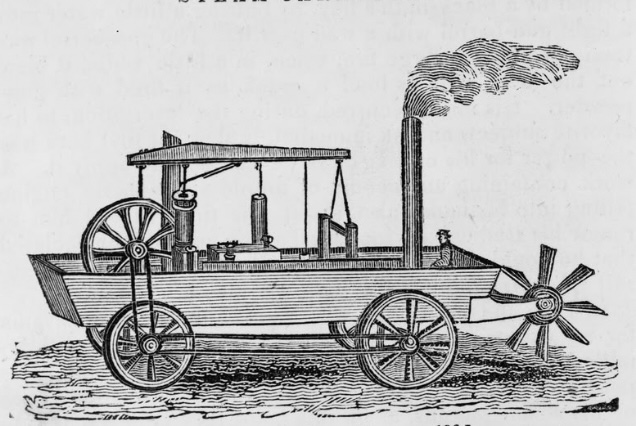
Before the motorcar, before the railroad (which he foresaw2), Oliver Evans created and operated the first self-propelled amphibious vehicle, and the first self-propelled land vehicle in the New World. Evans’ accomplishments are easily on par with those of Thomas Edison and Henry Ford. By the time that he died in 1819, Evans’ flour mills and high-pressure steam engines, both protected by patent, made him a wealthy man.
In many ways, Oliver Evans was the Elon Musk of his day: brilliant, impatient, abrasive, alienating to his contemporaries, and financially successful. For Oliver Evans, the U.S. patent system made it possible.
1 …but not very well. The Board of Health wrote off the Oruktor Amphibilos in 1808, selling the $4,000.00 machine for $31.10.
2 In 1813, Evans wrote: “The time will come when people will travel in stages moved by steam engines, from one city to another, almost as fast as birds fly….A carriage will set out from Washington in the morning, the passenger will breakfast in Baltimore, dine at Philadelphia and sup at New York on the same day….”
— Robert Yarbrough, Esq.